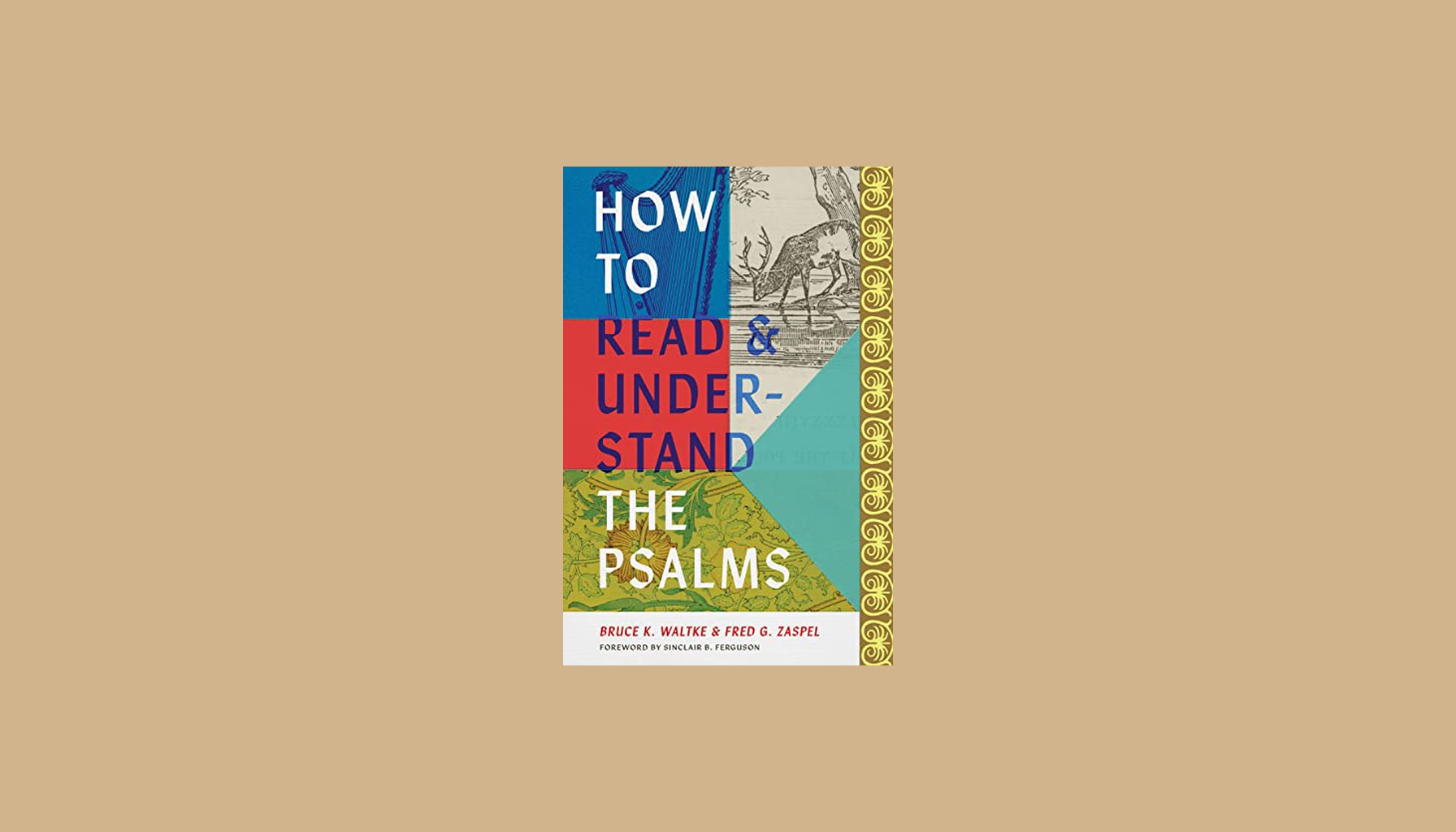
by Bruce K. Waltke and Fred G. Zaspel
Crossway, 2022 | 608 pages
Here is Sinclair Ferguson’s Foreword to this book:
It is a privilege to serve as herald to Drs Bruce Waltke and Fred Zaspel as they step forward to offer this outstanding volume to all lovers of the Book of Psalms. Do not let its workmanlike title dampen either your interest or enthusiasm; you are in for a treat in the almost 600 pages that follow. Although neither a prophet nor a prophet’s son, I think I can safely predict that How to Read and Understand the Psalms is a book you will return to frequently and treasure permanently.
The conception, birth, and maturation of this work are explained by the authors in their Preface. Together they bring to its pages an array of gifts and graces: Bruce Waltke has for many years been regarded as a prince, perhaps even a king among Old Testament scholars; Fred Zaspel has put many of us in his debt through his outstanding works on the great Princeton theologian Benjamin B. Warfield. Perhaps there is something more than merely whimsical in the thought that their collegial work echoes some of the conversations the great Old Testament theologian Geerhardus Vos shared with Warfield on their regular constitutionals around Princeton Seminary. At any rate, the combination of Old Testament Theologian and Systematic Theologian is an irresistible one!
Here, then, in their combined labours, we are given rich exposition of the Psalms rooted in careful study of the Hebrew text, distilled through a well-matured and reflective mind, and brought together in this form by two humble lovers of Scripture. This is the work of two disciples of the One who, more than any other, knew, loved, understood, and applied to himself the Book of Psalms. For this reason alone, even were there no others, a book such as this, on the words that helped shape and inform both our Lord’s self-understanding and his own emotional and affective life and experience, deserves to become our regular companion along the pilgrim way to the heavenly Zion.
Readers familiar with the work of either or both of these two “doctors of the church” will open these pages with high confidence and anticipation of finding good things. To that confidence I would like to add a word of personal testimony.
I have the privilege of being what the older writers would have quaintly called a “sometime colleague” to Professor Waltke at Westminster Theological Seminary in Philadelphia. Three scenes come to mind that may help readers catch a glimpse of the man himself. Dr. Waltke will remember none of them—underlining the fact that his impact on others has been far greater than he himself could ever imagine.
The first well-remembered scene is of a “water-fountain” (or, more accurately, “coffee-pot) conversation at the beginning of a new academic year. As though talking to himself as much as to me, Professor Waltke commented on the way he had been praying for the help of the Holy Spirit as he looked forward to teaching his students in the coming semester. They, I am sure, believed that his expertise far surpassed the sum total of the sum total their knowledge. Yet the abiding memory is of his dependence on the Lord—a reminder to a junior colleague, as well as to his students, that while one plants and another waters, but only God can give the increase.
A second remembered scene takes me back to a dinner conversation at the table of friends whose guests we both were. Dr. Waltke was, at that time, writing his magisterial two-volume commentary on the Book of Proverbs. As we talked about various things it was clear Proverbs was much on his mind. What was evident to me was that C. H. Spurgeon’s famous words about John Bunyan (“Prick him anywhere and he bleeds Bibline”) could be reapplied to my fellow dinner guest: “Prick him anywhere, and he will bleed Proverbline!” Sacred Scripture had —as Paul put it to the Thessalonians—been received by him “not as the words of men but as what it really is, the word of God, which is at work in you . . .” (1 Thess. 2:13).
The third scene is directly related to the theme of this book. It is the memory of an unspoken aspiration experienced while sitting listening to Dr. Waltke expound Psalm 51: “Would that, somehow, this richly satisfying exposition, and many more like it, were available to a wider public!” In view of his many commitments, my hope was, confessedly, not accompanied by great faith. But now, thankfully, the sight of these pages is a rebuke I gladly welcome (“O you of little faith”!).
Dr. Fred Zaspel has also been a friend over many years—a friendship initiated (I suspect) by a common concern for pastoral exposition that combines biblical exegesis with biblical theology and is given depth by the penetration of biblical logic that leads to health-giving theology and fruitfulness in ministry. With many others I am indebted to, and have derived benefit from, his important contributions to the study of the multifaceted writings of B.B. Warfield. In addition, he has been a means of encouraging the people of God to understand that in some measure “we are what we read.” With all this Dr. Zaspel has been an encourager of other authors and at times their editor, thus exercising a ministry to his fellow Christians that has often been hidden from public view.
From a more personal viewpoint, as someone belonging to the circle of friends who have known Dr. Zaspel and his wife Kim for many years, I have witnessed the ways in which they have walked together with grace over the sometimes rough and testing pilgrim path, and followed in the footsteps of the psalmist. It has been moving to watch from a distance as they have found God’s strength and provision to be as real for them as it was for David. And as surely as he was able to echo the Patriarch Jacob’s testimony that the Lord had been his lifelong Shepherd, so too Fred and Kim have relied on, and known, the Lord’s sure presence.
There is something especially fitting, therefore, that the gifts, graces, and experience of our two doctors have combined to provide this exposition of the book that John Calvin wrote “contains an anatomy of all the parts of the soul.” In this exposition of the Psalms, then, these pages present spiritual instruction for the mind and medicine for the soul.
But the herald must refrain from detaining readers any longer by adding to these introductory fanfares! So, with these words of introduction to the authors who will guide you through the varied spiritual terrain of the psalter, I happily exit stage left and leave you to enjoy and profit from How to Read and Understand the Psalms. As you make the ascent of the hill of the Lord you will, I feel sure, frequently retain the services of your expert guides Bruce Waltke and Fred Zaspel until, by God’s grace, the summit is in sight for us all.
Sinclair B Ferguson
Chancellor’s Professor of Systematic Theology
Reformed Theological Seminary